Prostate
Short-answer questions
2Describe capsules (coverings), lobes and zones of prostate.
Prostate is an accessory male-sex gland (Its secretions form major portion of seminal fluid), situated below the neck of urinary bladder. It surrounds proximal part of urethra.
Capsules (coverings) of prostate
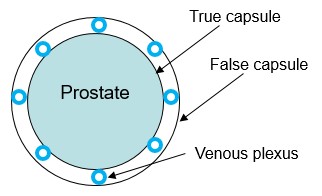
The prostate has inner TRUE and outer FALSE capsules
- TRUE capsule is formed by condensation of the stroma of the prostate.
- FALSE capsule is formed from pelvic fascia.
- Space between the two capsules contains prostatic venous plexus. * That is why during prostatectomy, prostate is removed but both the capsules are kept behind to prevent haemorrhage.
©2026 Epomedicine | WordPress Theme by SuperbThemes
Lobes of the prostate
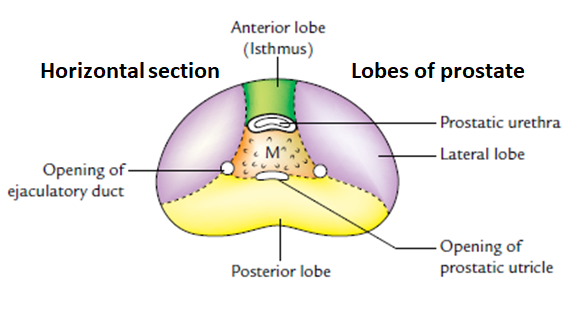
Anatomically 5 lobes * (median, anterior, posterior & 2 lateral). Anterior lobe is devoid of glandular tissue.
Median lobe is wedge shaped. It lies between upper part of urethra in front and ejaculatory ducts behind. It produces an elevation (uvula vesicae) at the apex of trigone of bladder.
© Vishramsingh - Anatomy Vol. II
*According to current view, instead of lobes, prostate is divided into zones as it correlates better with its pathology.
Zones of the prostate
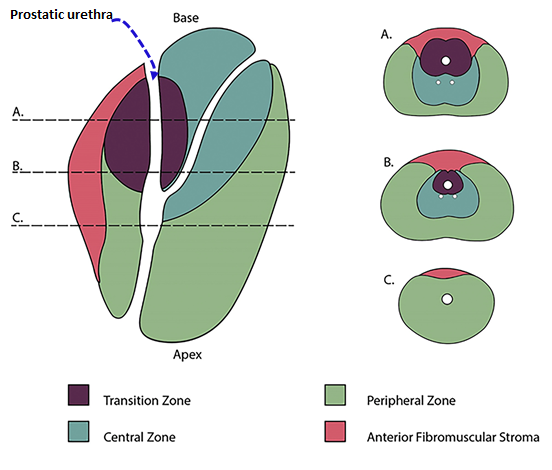
Sagittal and transverse section of prostate showing zones© 2026 Elsevier Inc.
- Peripheral zone (70% of glandular tissue) - situated posterolaterally. * Prone for carcinoma.
- Central zone (25% glandular tissue) - around transitional zone
- Periurethral Transitional zone (5% glandular tissue) - around the prostatic urethra. *Prone for benign prostatic hypertrophy (BPH)
- Anteriorly no glands, only fibromuscular tissue
Describe applied anatomy of Prostate.
Applied anatomy of prostate
1. Benign prostatic hypertrophy (BPH): Adenoma
- Most common in the periurethral transitional zone/median lobe of prostate. Occurs after 50 years of age
- Hypertrophy of median lobe leads to protrusion of uvula vesicae inside bladder. When bladder contracts for urination, the enlarged uvula vesicae protrudes into urethral opening like a valve and blocks it. So when the patient strains, urine cannot pass, but when he relaxes, the valve gets retracted and urine is passed. Also distortion of urethra by the adenoma causes incomplete emptying of bladder.
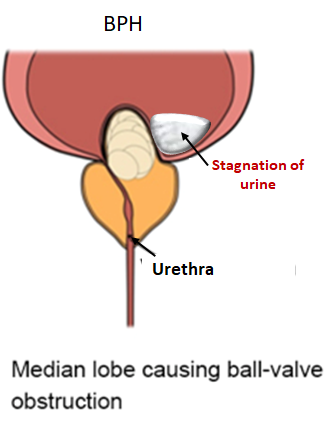
BPH - Enlarged Uvula vesicae - median lobe© Second Military Medical University
2. Carcinoma of the prostate: Most common in peripheral zone. Metastasis can occur towards vertebrae due to valveless connection between prostatic and vertebral venous plexuses.
3. Per rectal digital examination of prostate:
- In BPH - the enlarged prostate is firm, smooth and nontender
- In Carcinoma - it is nodular, hard, fixed and painful
4. Prostatectomy: removal of prostate
- Done if cannot be treated by medicine (conservatively)
- Enlarged gland is enucleated (means both the capsules along with the venous plexus between them are not removed to prevent bleeding). In BPH partial gland as per amount of growth is removed. But in carcinoma, radical prostatectomy with removal of entire prostate, seminal vescicles and surrounding lymph nodes is done.
- It is done by different approaches: Transurethral approach (through urethra) is very common. Other approaches are transvescial (through bladder), transpubic, and perineal.